






« Winners for Challenge 7A | Main | The Punchcard »
December 12, 2005
CHALLENGE 8B SECOND HINT
The photo is back from the lab and they've got rid of all of the glare. The rotor is still a pretty tangled maze, but I'll get out my jeweller's loup and see if I can disentangle any of it for Thursday. Meanwhile I was reading through my notes on the machine:
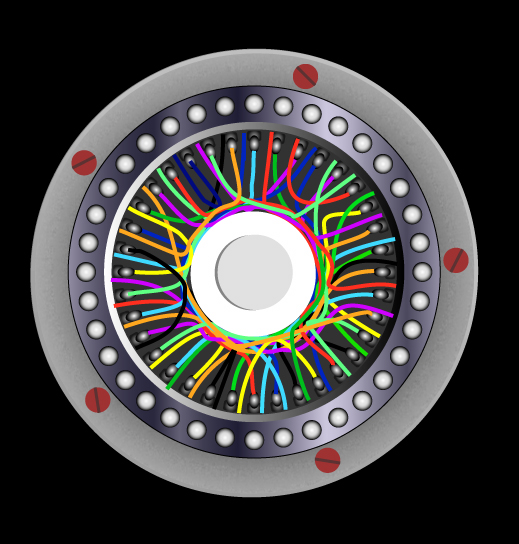
1. The rotor nearest the plugboard is the fast one. It turns away from the keyboard once every key press, after the key is pressed and the lamp has lit.
2. The next rotor turns once every 36 key presses (again after the lamp has lit) but the first time it turns in each message does depend on how the machine is set up. It turns towards the keyboard.
3. When the key is pressed the current flows through the punchcard assembly, through the first rotor from right to left, through the second rotor from right to left, through the reflector wiring, back through the second rotor from left to right through the first rotor from left to right, back through the punchcard assembly and to the lamps.
4. The punchcard is hard to read so I had a cipher clerk put a grid on it to help you. Here it is again:

Posted by Harry at December 12, 2005 02:53 PM
Comments
If you wish to leave a comment please act responsibly. No personal or innapropriate comments should be made. Concerns about a comment should be emailed directly to us here. Hints about the challenges may be blocked or held back at our discretion. We reserve the right to refuse to publish comments without entering into a discussion about why, and to censor comments as we see fit. Please be patient if it takes a while for your comments to be approved.
You don't mean to say that the rotor photo could be the wrong way round, surely!!!! Why would it be printed the wrong way round? It isn't is it?
[Could be,it was a common mistake in old fashioned photo labs. Mind you it might not be, I just want to leave as many possibilities open as I can. Harry]
Posted by: Jason at December 15, 2005 04:58 PM
Harry,
I don't think what you just said to Robert is true. Changing the direction in which the wiring maze is inserted isn't the same as changing the order of the letters on the rotor housings. To compensate for the effect of changing the order of the letters on the rotor housings you would need to reflect the wiring maze in a vertical plane. Changing the direction in which the wiring maze is inserted is equivalent to rotating the wiring maze about a vertical axis.
A nice trick of yours to tell us the direction in which the rotors moved but neglecting to say that the letters were written on the rotor housings in the wrong order!
[Since you don't know which is the back or front of the wiring maze you can't tell the difference between the rotation or the reflection! Harry]
[PS, Are you assuming the photo has been printed the right way round? Harry]
Posted by: Seamus at December 15, 2005 12:58 AM
I don't quite understand your last comment, Harry - unless the rotor housings were numbered in the "wrong" direction (i.e. anticlockwise as viewed from the input side, unlike almost every other rotor machine in history), then moving away from the keyboard would take you from A to 9, not from A to B. I think :)
[Two points. 1. This is a made up machine which is deliberately different from historical machines so that it is hard to use off the peg software to crack it. 2. Since you don't know which way the wiring maze is inserted it is irrelevant. Harry]
Posted by: Robert at December 13, 2005 05:40 PM
When you say the first rotor turns away from the keyboard, do you mean it goes from A to B, or from A to 9. Is the arial view of a rotor:
|B|
|A|
|9|
or
|9|
|A|
|B|
?
[IF the intial setting shows A at the top then after the first key press you would see B at the top. Harry]
Posted by: Captain Cool at December 13, 2005 02:17 PM
It's leading diagonal is the line y = -x yes?
[Yes, Harry]
Posted by: Captain Cool at December 13, 2005 01:28 PM
Have you said whether the rotors can be back to front or not yet?
[I'm not sure. They could be. Harry]
Posted by: Ben at December 13, 2005 08:13 AM
The vigenere+monoalphabetic cipher is called a Quagmire II by the American Cryptogram Association:
http://www.cryptogram.org/cipher_types
Given a decent crib, it isn't too hard to crack. The Quagmire III and IV ciphers are a bit more difficult.
Posted by: mark at December 13, 2005 02:51 AM
How can there only be two permutations of the card. Consider the 2 dots in the bottom right-hand corner. Rotate the card 90° anticlockwise the two are in the right hand corner. Rotate 90° again and then again. These are 4 permutations.
[we worked out (in one of the comments) it had to be symmetric on its leading diagonal. Harry]
Posted by: Ben at December 12, 2005 11:11 PM
Someone else is using my name in the next thread, and after I did as well!
The symmetry which was not present before makes the number of possible punchcard settings equal to 4 (that is, flipping over the card makes no difference. You say 2, have I missed something?)
[I think so. Harry]
Harry, it was not a question about the punchcard from Tom but the order of symbols, and by looking at the original PDF it is:
0123456789abcdefghijklmnopqrstuvwxyz
[Yes, Harry]
This vigenère + monoalphabetic idea is interesting. It does produce a polyalphabetic cipher with 26 alphabets, using only 2 simple keywords. Even though the vigenère keyword length can be found as easily as ever, getting the 26 alphabets is much harder. All the letter frequencies are scattered around in the order of the monoalphabetic cipher. I suppose you would have to find the monoalphabetic cipher by making ALL vigenère cipher parts into the standard frequency distribution. I'm sure there's a good method to do this. I'll need to think about that some more. Then you simply solve the vigenère. Hmmm. It isn't easy to solve I don't think.
I still haven't had time to actually implement my almost complete design yet (always changing)! Maybe tomorrow... 55 million doesn't sound computable, but I don't know how many my program can cut from the possibilities. I'd better make it and see I suppose! I'm following my normal practice of making the program customisable and with all error handling. I'm probably just slowing myself down though. Who else is doing such a thing?
Posted by: Jason at December 12, 2005 10:45 PM
so even somebody with their script couldnt crack it without the plugboard settings :P
chidders
[I think the plugboard error would have allowed most of the text to be cracked and the corrections to be hand made to be honest. Harry]
Posted by: chidders at December 12, 2005 08:50 PM
um is all of the card symetrical? only i got about 3 letters which werent. is this my mistake or yours harry, or is it a twist?
chidders
[Two of them were wrong (I hope only two). I am trying to post the correct version now! Harry]
Posted by: chidders at December 12, 2005 08:29 PM
how many correct entries now harry? have the rotor wirings finally helped someone crack it?
chidders
[Still none. Harry]
Posted by: chidders at December 12, 2005 08:27 PM
Harry, the original punchcard wasn't symmetrical in any axis, it was 1 or 2 points out in the line y = -x, however, the new punchcard you have published on the grid IS symmetrical :/
[It is supposed to be symmetrical - see other posts for my humble apologies. Harry]
Posted by: Captain Cool at December 12, 2005 08:23 PM
Just to add to what Ruth said - is the punchcard supposed to be symmetrical (it would need to be to simulate an Enigma plugboard)? In its current form it is very nearly symmetrical, but not quite.
[That is right, see my post earlier. I will correct the punchcard and post it (Hopefully in the next few minutes) Million apologies. No one has got close enought for it to make a difference yet thankfully. Harry.]
Posted by: Robert at December 12, 2005 08:15 PM
Notice that the hints on the direction of rotation haven't really reduced the number of possibilities. This is because reversing both wiring mazes in their rotors - which is allowed - is logically equivalent to reversing the direction of rotation. Reversing ONE wiring maze, and not the other, gives you yet different possibilities.
Besides which, you don't know (a) which side of the rotor you are viewing, right or left; (b) which ring of contacts, the inner or the outer, is the left (reflector) side; (c) which way around the rim is forward in the alphabet.
Some of these uncertainties are equivalent to each other, but the possibilities would still seem to be 36 x 36 (initial rotor positions) x 36 (reflector positions, w.r.t. the entry ring) x 36 (positions for Z, the slow-rotor-driver) x 4 (maze orientations) x 2 (interpretations of which ring of contacts is which) x 2 (rotor orders) x 8 (punchcard positions) = almost 215 million. That's assuming you know the rotor wirings perfectly.
[If you have followed the discussions about the punchcard I think we are down to only two possibilities for that instead of 8 so we are down to around 55 million possibilities. Harry]
Posted by: John at December 12, 2005 08:15 PM
Okay, I've improved my checking:
1. Because of the remarkable symmetry in the card, any what way I put it in will give large amounts of plaintext.
2. My rotor options make so little difference anything I put in will give large amounts of plaintext.
3. So I only really need to look at the maze orderings, rotor starting positions and the ambiguous information that Harry's given and see what gives a lot of text :D
ANY SOLVERS YET????
Posted by: Ian at December 12, 2005 08:15 PM
ah, found the missing link in my personal jigsaw. realised i got a few plaintext letters (i had found about 20) wrong, but i think ive got a few right now. i still have to see whether it will help me to crack it :P
chidders
Posted by: chidders at December 12, 2005 07:11 PM
Just to clarify Harry, the rows and columns on the punch card go "0123456789ABCDEFGHIJKLMNOPQRSTUVWXYZ" not "ABCDEFGHIJKLMNOPQRSTUVWXYZ0123456789"???
[I haven't told you that yet. Harry.
Posted by: tom at December 12, 2005 07:08 PM
i havent even looked at rotor2 yet :P
i was wondering for those of you who have done rotor2 whether it is merely a question of brute force or whether you still need another clue.
if u dont want to tell me then fine :P
chidders
Posted by: chidders at December 12, 2005 07:06 PM
Shopuldn't the punch card be symetrical on the diagonal? From what it says in the pdf, if a hole was in g,8 for example g after going through the rotors would become 8 and 8 would become g so it would have the same effect as if it was in 8,g. each letter can only become one because the punchcard is basically a monoalphabetic subsitution so the card has to be symetrical diagonally. It mostly but there are four holes which make it asymmetric. What have I got wrong? Is it symetrical, does it not have to be, or is the card wrong?
[Which diagonal? (I'll check there could be a typo, but it looks right to me. Harry]
Posted by: Ruth at December 12, 2005 07:03 PM
i guess :S
however, you wouldnt be able to use vigenere tools which would be a start.
with two keywords(vigenere and monoalphabetic) you are making quite a strong cipher, as with a long vigenere keyword(12 letters say) then you would need a long message to break it.
maybe challenge 6 next year harry :P
better than a vigenere anyway. thanks for telling me that by the way, stephen and ian as it stops the new cipher distracting me from the 8b challenge :P
chidders
Posted by: chidders at December 12, 2005 07:02 PM
Harry, which way is towards the plugboard? Is that A-->B or A-->9?
[I'm not sure I understand the question. Harry]
Posted by: Stephen Harris at December 12, 2005 06:59 PM
I'm afraid Chidders that the cipher you suggested can be broken. The monoalphabetic cipher does nothing to the frequency of the polyalphabetic cipher, and so, finding the highest IC number and its corresponding word length means that it can be frequency analysed. The only difference is that each 'column' of text that you have for each character of the keyword will not be enciphered with a ceasar shift type. Nevertheless, with large enough text, you can simply apply a monoalphabetic method to it, or you could attempt to find the monoalphabetic cipher and then use the ceasar shift on the resultant text to get the plaint text.
Posted by: Stephen Harris at December 12, 2005 06:50 PM
Bleh, I need a distraction :P
I suppose you'd have to brute-force the Vigenere keyword length, and on one of the splits you'd get a spiky frequency graph, so then of course the caesar shifts don't matter because of the monoalphabeticalness (although it hides any obvious keyword), so it's easy enough after that.
Posted by: Ian at December 12, 2005 06:46 PM
i dont want to distract people from challenge 8, but whilst investigating it i thought of an interesting hand cipher.
my idea was to encipher a message with a vigenere and then with a monoalphabetic
it cant be frequency analysed because of the vigenere, and you cant use the vigenere method because you need to know the monoalphabetic first :)
when people have finished challenge 8, id appreciate hearing what they thought about this cipher.
ah well, back to challenge 8 for me :S
chidders
Posted by: chidders at December 12, 2005 06:36 PM
How many solvers Harry?
P.S. Got Rotor 2 down to 144 possibilities :D
So iterations needed now is 9 (Reflector) * 16 (Rotor1) * 144 (Rotor2) * 26³ (Starting positions) * 8 (wiring options) * 8 (card options) = 23000000000 :P
Unless of course number 3 implies that the rotor ordering is 1 then 2?
Posted by: Ian at December 12, 2005 06:23 PM
not making much headway :S
how many submissons so far harry?
chidders
[None correct yet. Harry]
Posted by: chidders at December 12, 2005 05:48 PM
Is the punchcard orientated in the correct way it should be put in?
[I'm afraid I don't have any notes on that. Were there any other clues? Harry]
Posted by: Captain Cool at December 12, 2005 05:36 PM